Showing posts with label 5. Show all posts

Monday, June 4, 2018

Roman Mosaics

At the end of every school year there is almost enough time for fifth grade to complete one last project: Roman mosaics. In the past, I've had every student create an animal, but this year I allowed for a subject matter of choice. The only real requirements were that students needed to be able to draw the image without a computer reference photo and that it needed to be large enough to be able to fill with small pieces of construction paper. Students first drew a light outline of their subject and proceeded to fill the image in with small construction paper shapes. Many students worked with squares, but others got creative and cut pieces that would fit the spaces they needed. The key to creating a mosaic is that there needs to be space in between the shapes; if the tiles were overlapping, that would be a collage, not a mosaic. Since gluing small pieces of paper together is such a lengthy process, I think next year I want students to create their mosaics by drawing them. I assign drawn mosaics as a homework assignment, many of which came back very detailed, so I think allowing them to draw the mosaic instead of cut and glue it would provide many benefits: 1) Students would actually finish before the end of the school year. 2) It makes it easier to fill small areas with tiny shapes when they are drawn with a sharp utensil. 3) Students can add value by coloring the areas in with multiple hues instead of using the plain construction paper that we have in the art room. I am hoping that I will have several artworks completed before the end of the school year so I can add them to the virtual art show. After today there are only nine days of school left!


This artist is cutting out shapes that will fit together harmoniously like puzzle pieces.


This is an example of the drawn homework mosaic. This student used a variety of shades to make her quetzal look more realistic and varying shape sizes to emphasize the bird!


Tuesday, May 8, 2018

Terracotta Soldiers

A couple of weeks ago I introduced a lesson to fifth grade about Emperor Qin's Terracotta Army. What I like most about this project is the process: artists create their own soldier relief print! The first year that I taught this I allowed students to create either a human or an animal, since the tomb contained soldiers, government officials, acrobats, and exotic animals, just to name a few, but this year I decided that all students should create a human of some sort. I provided them with several reference photos, but they all still look completely different! Here are a few rough drafts from 5B:


Once students planned their artwork, they drew their soldiers onto foam and etched into the surface. In a relief print, all the etched areas show up "empty" when they are printed, while raised areas are printed with ink. Traditional relief prints are created by etching into a hard surface, like wood or linoleum, and use printmaking ink (I prefer BLICK), but in the FCCS art room we use tempera paint. Students spread tempera paint along their relief block, carefully flip it paint side down on to paper, gently rub and press the back of the stamp, and slowly peel the soldier off the page to reveal a relief!


When my first group of students worked on this project, I had them glue the smaller colored papers together to create a collage (inspired by Andy Warhol, to show the same image four or so different ways), but this year, I'm not sure how I want students to arrange their artwork. Perhaps the small prints are complete the way they are? One student proposed stamping their soldiers in another color, so maybe next class I'll let them choose other colors and they can collage their soldiers using a wider variety of color. Check back in a couple of weeks to see the final artwork on the Virtual Art Show or follow my Instagram for more frequent pictures!

Sunday, February 18, 2018

Greek Sculpture Update

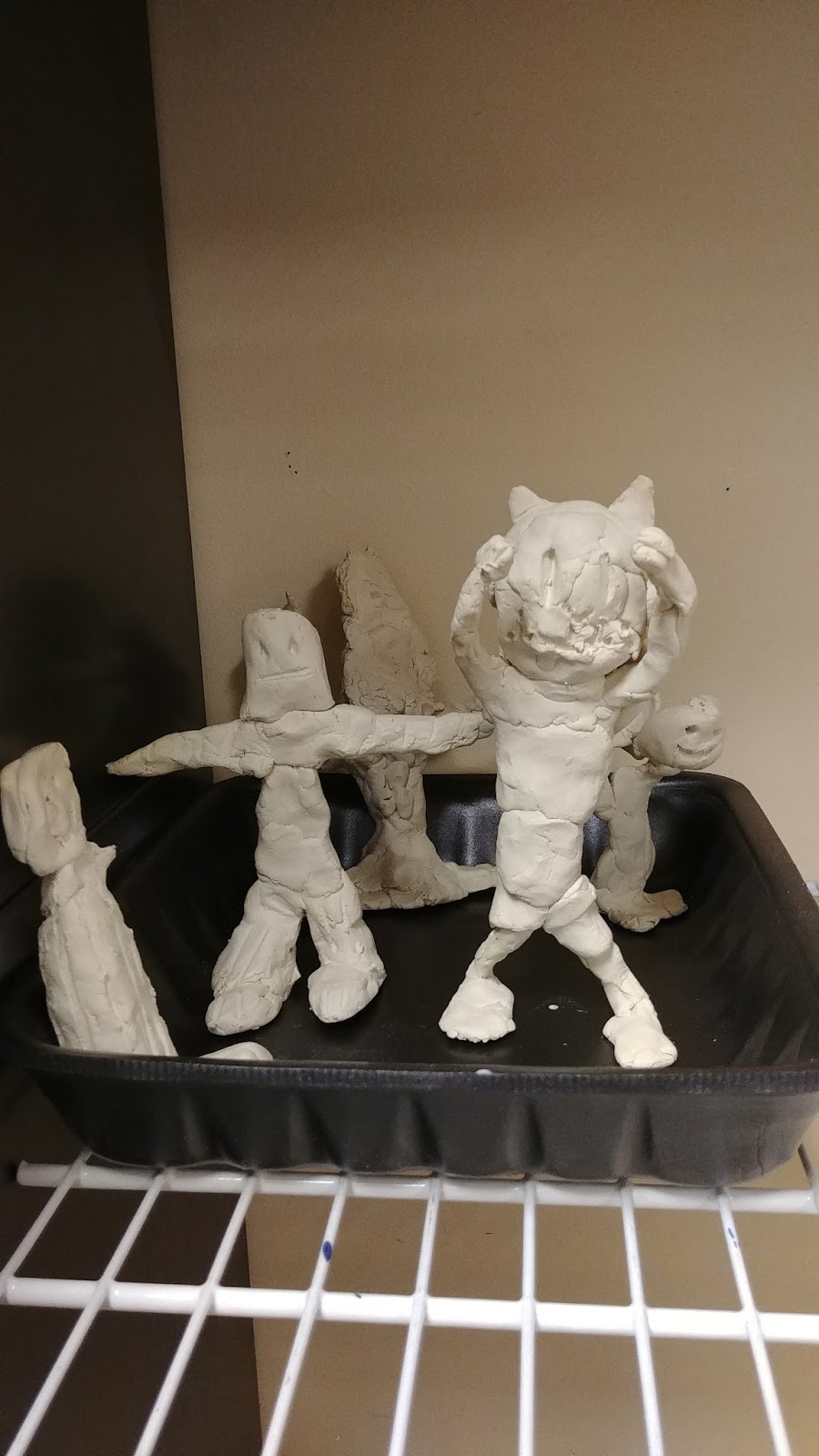
This past week, fifth grade artists molded air-dry clay over top of their wire armatures. Students had so much fun with this portion of the project and it yielded great results! Here are some in-progress and final photos of the sculptures:


Throughout this project, students have overcome so many hardships - I am so proud of their hard work! These forty students have shown the most patience, diligence, and constancy in the last couple of weeks! I have heard feedback from students and have thought of new ideas that would have made this project even more successful. One student suggested that this solely be a wire sculpture project. I'm not opposed to that; the wire sculptures looked awesome and most of them stood up well. I know for next time that I need to purchase thinner wire so that it is easier to bend, or supply more tools to manipulate the wire with. We use air-dry clay at FCCS because we do not have a kiln in our building, but maybe next year I could talk with my art teacher colleagues and see if we could use a kiln in their school! I would need to buy proper clay and cut out the step of building the wire armature (since it would melt and explode), but the final sculptures would be sturdier this way. I also think that by dividing the clay into bags for each student ahead of time made the clay dry out quicker, resulting in all the cracks in the solid statues. I have thankfully not had any casualties yet, but as precaution, I'm going to apply a layer of mod podge over the sculptures to prevent any limbs from breaking off before students paint this week. 

Stay tuned for the final product in the next couple of weeks!

Sunday, February 4, 2018

Greek Sculptures

Fifth grade artists have been showing great patience and working diligently the last two weeks while creating wire armatures for their Greek-inspired sculptures. First, they had to choose which Ancient Greek sculpture style they wanted to portray in their artwork: Archaic, Classical, or Hellenistic. Next, they had to draw a rough draft in their sketchbook of either a person they knew, a Greek god or goddess, or an animal that displayed qualities of their desired sculpture style. Once rough drafts were completed, students took to using a variety of wire, pliers, and wire cutters to twist, bend, cut, and shape the "skeleton" for the inside of their sculpture. Next step is to sculpt on clay!

Here are a few excellent examples of the wire armatures:


Thursday, December 7, 2017

5th Grade

5th grade has been doing a tremendous job working on their assignments both in and out of the classroom. During the month of November, students were given another Doodle Calendar to complete; this time, the calendar was predominantly comprised of depictions of the Greek gods or goddesses we discussed in class. Creating a drawing of a symbol or pyhsical representation of each god or goddess helped students practice for the subject matter of their two Ancient Greek projects as well as help them to remember the significance of each god or goddess in Greek mythology. Here are a few of the outstanding Doodle Calendars:


Students have been using Chromebooks in class to access the Ancient Greek Symbaloo I put together in order to plan their Greek Vase compositions. Students had to chose any vase shape to draw and fill with either a scene, a character, or a symbol from Greek mythology, and complete it with a variety of Greek-inspired patterns. Students planned the drawings out in their sketchbooks first and have been working on transferring their ideas to their handmade scratch art paper. I am so pleased with the outcome of this project! I have never tried using scratch art for this project, and as it is more difficult because students must work slowly and have a secure plan, the final product is beautiful! The last update I posted including rough draft drawings from 5A, so here are a few I snapped from 5B today:


You will just have to wait to see the final artwork when I update the Virtual Art Show next week!