Sixth grade artists completed all their projects in time to work on one more! Two years ago I introduced metal repoussé to the then-sixth graders through a short end-of-the-year heraldry project (see below).
Last year I started the year with an illuminated letter portfolio cover project, but I skipped over that this year. I thought the best way to combine the two projects was to have students created an illuminated letter with embossed metal... and I LOVE the outcome! Students worked on a small scale since we only have a few days left. I did not require them to fill the page, but for next year I think I want to have students fill the entire metal with designs and then glue them to paper where they extend the designs even further. I will be updating the Virtual Art Show soon, but until then, enjoy some of these in-progress photos!
Showing posts with label 6. Show all posts
Friday, June 8, 2018
Friday, May 18, 2018
Watercolor Landscapes
I think I say this about all the projects, but the 6th grade watercolor landscapes might be my actual favorite project. I was so resistant to using watercolor paints almost my whole life, but after taking a watercolor exploratory class at Hood College (shout out to Gary Cuddington being the BEST painting instructor), I realized that watercolor wasn't scary. What I like most about watercolor painting is the variety of abstract techniques that artists can use to create subject matter. Watercolor is meant to be loose and fluid (hence the name watercolor), but it doesn't have to be; it is up to the artist to decide.
I always start this project by discussing what makes up a landscape. I have a slideshow with images of Chinese watercolor paintings and students practice drawing several elements in their sketchbooks. After they have experienced the elements that make up a landscape, I introduce watercolor techniques. As I discuss the different techniques I like to give them ideas about which techniques would work best for the different landscape elements. It also allows students to think about which techniques they want to use while they are planning their rough drafts. Students are provided a list of landscape elements and must incorporate at least five of them into their painting while demonstrating at least three of the watercolor techniques.
Students try out flat wash, gradient wash, wet-in-wet, dry brush, wax resist and what I call "lift off," which makes me think of rockets every time I say it, but the name fits the technique well. I have students put crumpled up tissue paper on top of wet paint so when they lift it off (see, lift off) it leaves behind a textured appearance. For this particular project, lift off is a great technique for rocks. Anyway, after students learn the techniques, they created rough drafts in their sketchbooks, which were quickly turned into watercolor paintings.
It looks as if the whole class will be finished their paintings on Monday or Wednesday next week, so I will be updating the Virtual Art Show shortly. I look forward to sharing their finished masterpieces!
Monday, December 11, 2017
Happy Monday!
Today marks the first day of the 15th week of school! 6th and 8th grade artists were so productive today that I just wanted to brag about them a little bit. 😀
6th grade weavings have finally begun! After demonstrating patience while slowly learning several weaving techniques, artists are chosing to use three within their composition in order to convey a specific theme. Students are chosing to either convey their theme through a literal representation (e.g. weaving a picture) or through color that represents their theme. I'll post more pictures right before Winter Break when students are sure to have nearly half of their weavings complete.
Last week, 8th graders glued their magazine cutouts to scratch art paper and started adding their zentangles. This project, Gustav Klimt Scratch Art, is borrowed from a great mentor of mine, Ms. Neel; students were creating this project while I was student teaching and I loved the outcome so much that I brought it to FCCS. Artists are putting their magazine cutout within a space, creating foreground, middleground, and background, and drawing with mostly contour lines so they can fill their empty space with a variety of zentangles, a form of soothing dooding. To set the mood, we are listening to relaxing music, which really seems to be inspiring the artists - take a look for yourself!
Each day my artists surprise me with more and more talented, creative ideas!
Monday, November 20, 2017
Term II Update
Good morning artists & families!
The start of Term II brings forth new projects for every class. Fifth grade started Greek Vase Painting, but with a twist! In the past I have taught this project where students are using Sharpies to draw a traditional looking Greek vase depicting a scene from mythology, but this year, students created their own scratch art paper and will etch their designs in the paper. The Element focus of this project is space and etching away from the surface will be a great way for artists to understand negative space. Below are some examples of the artist's rough drafts. They have been using Chromebooks to access links on a Symbaloo (on the 5th grade page) to help them with their depiction of mythology. Once their entire rough draft is drawn, they will then color in the areas they want to keep black and the areas that are going to be etched to reveal the red.
Sixth grade artists just started Medieval Weavings. So far, students have learned the key words loom, warp, weft, and shuttle and have created their looms. Next, students will practice various weaving techniques so they are prepared to create a tapestry weaving incorporating at least three different techniques. Seventh grade was introduced to Stained Glass Windows last week and have been working diligently on rough drafts. Students were given choice in the subject matter of their artwork, the only requirement is that the image is broken up by window panes to simulate the intricate designs of actual stained glass. Artists will be using acrylic paint to create their designs on a piece of glass that will sit inside a small picture frame. Here are examples of a few rough drafts:
Eighth grade artists viewed a presentation on Art Nouveau and the artist Gustav Klimt. Their next project is to create a Klimt-inspired composition by surrounding a human figure with a scene filled with Zentangles. So far, students have found an image from a magazine, cut it out, and are working on a rough draft. They will access a Symbaloo on my website (under the 8th grade tab) that provides them with several examples on Zentangles and ideas from past student artwork. Below is an example from an artists in 2015:
The start of Term II brings forth new projects for every class. Fifth grade started Greek Vase Painting, but with a twist! In the past I have taught this project where students are using Sharpies to draw a traditional looking Greek vase depicting a scene from mythology, but this year, students created their own scratch art paper and will etch their designs in the paper. The Element focus of this project is space and etching away from the surface will be a great way for artists to understand negative space. Below are some examples of the artist's rough drafts. They have been using Chromebooks to access links on a Symbaloo (on the 5th grade page) to help them with their depiction of mythology. Once their entire rough draft is drawn, they will then color in the areas they want to keep black and the areas that are going to be etched to reveal the red.
Sixth grade artists just started Medieval Weavings. So far, students have learned the key words loom, warp, weft, and shuttle and have created their looms. Next, students will practice various weaving techniques so they are prepared to create a tapestry weaving incorporating at least three different techniques. Seventh grade was introduced to Stained Glass Windows last week and have been working diligently on rough drafts. Students were given choice in the subject matter of their artwork, the only requirement is that the image is broken up by window panes to simulate the intricate designs of actual stained glass. Artists will be using acrylic paint to create their designs on a piece of glass that will sit inside a small picture frame. Here are examples of a few rough drafts:
Ultimately, this is what the project will look like:
![]() |
| Teacher Sample |
As always, continue to check back on my blog to read about what is happening in the art room. I try to write a post at least once a week, so for more frequent updates follow me on Twitter and Instagram at @MsStrasserArt. I can't wait to see the masterpieces these young artists will create!
Labels:
5,
6,
7,
8,
Greek Vase,
Gustav Klimt,
Klimt,
rough draft,
scratch art,
space,
stained glass,
Symbaloo,
weaving,
Zentangles
Wednesday, May 10, 2017
Fortune Teller Critique
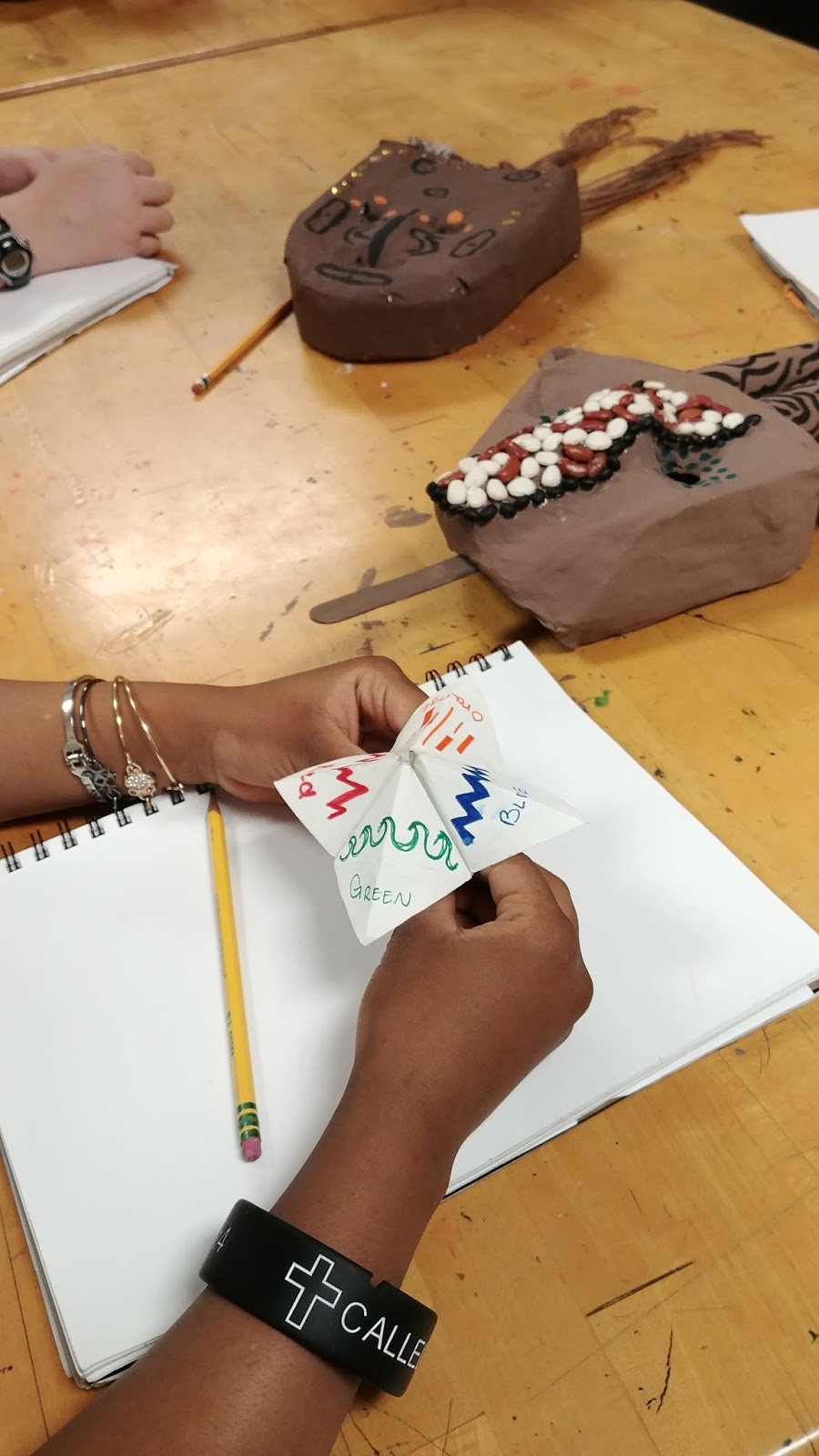
Today 6th grade artists engaged in a Fortune Teller Critique, which is something that I came up with when I was student teaching. Students worked in groups of 3 or 4 and used a paper fortune teller to generate questions to discuss about one another's artwork. The critique is very helpful in providing feedback about one's own artwork to use when they fill out their Artist Statement next class. Some of the questions included:
- What makes this artwork successful? How does it meet the objectives for the assignment?
- Discuss one Principle of Design used within the artwork?
- What does the artwork make you think about? Or what do you think the artist wanted you to think about?
Overall, I think the critique was a success! It allowed students to talk about topic other than Elements and Principles, and it will certainly help make the Artist Statement run smoother since they already have a lot of feedback!
Tuesday, April 25, 2017
Mask painting
6th grade students were just as happy as I was to have Art yesterday! Artists are working on painting their masks, using neutral colors first, and then adding emphasis to one area by adding a tertiary color. A lot of progress was made in class yesterday!
Monday, March 27, 2017
Papier-mâché Mask Update
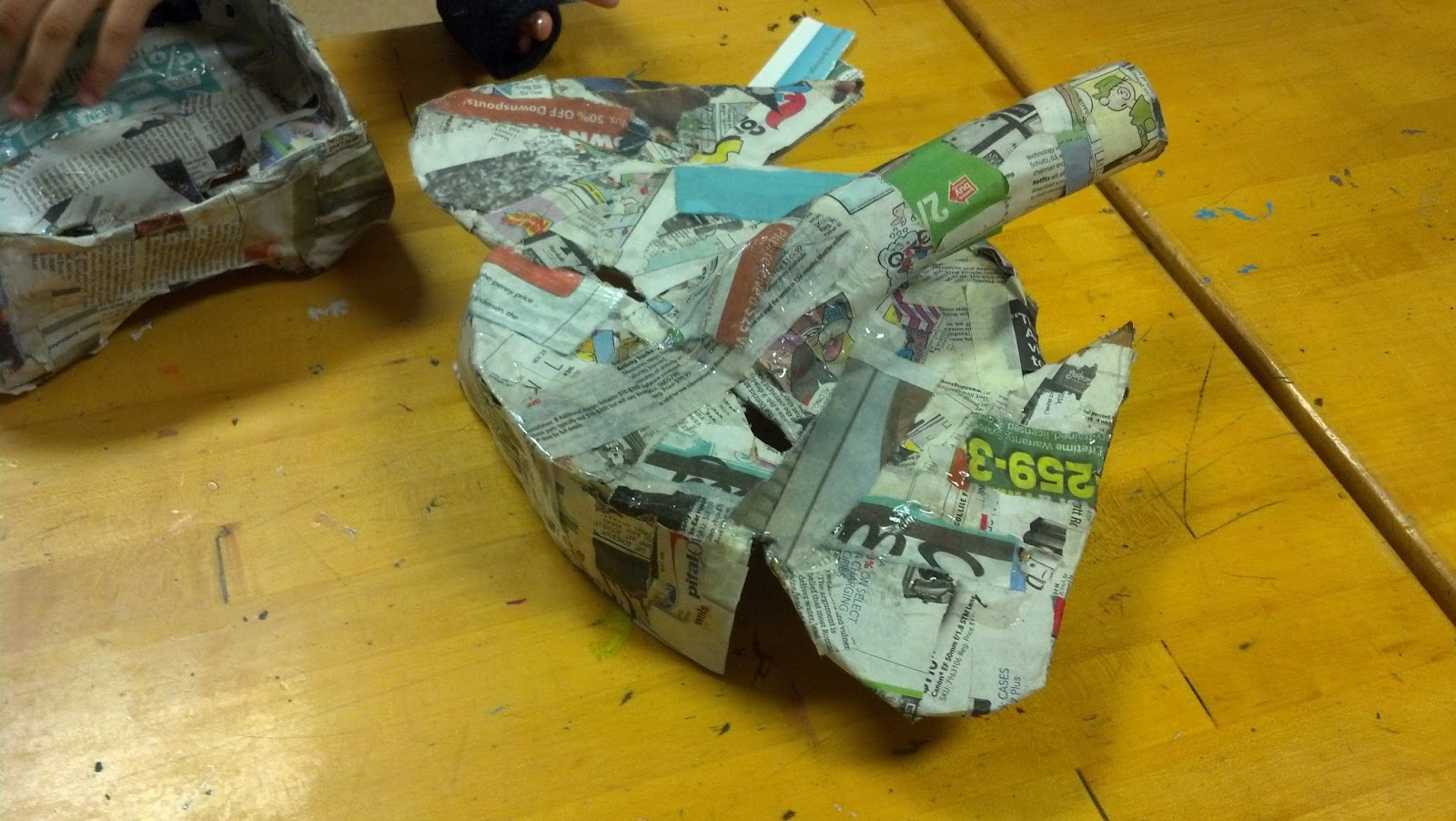
6th grade artists are finishing up with the Papier-mâché portion of the African mask project this week. The masks look fantastic! We started
Papier-mâché by using a mixture of watered down Elmer's glue, but switched over to a product called
Art Paste, which is specifically used for Papier-mâché. Below are some in-progress images of the
masks. Enjoy!
Papier-mâché by using a mixture of watered down Elmer's glue, but switched over to a product called
Art Paste, which is specifically used for Papier-mâché. Below are some in-progress images of the
masks. Enjoy!
Subscribe to:
Posts (Atom)